
Free audiobookNo sign-up
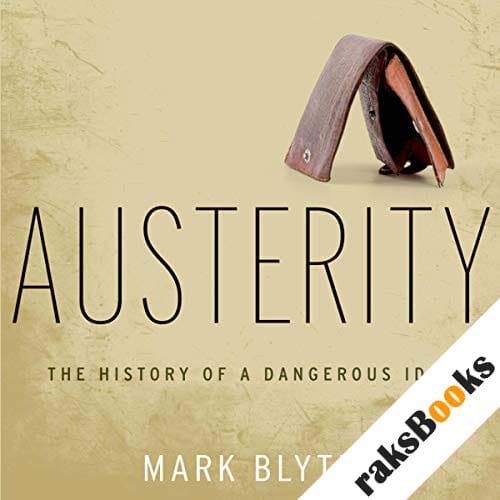
Austerity
The History of a Dangerous Idea

- Narrated by Fred Stella
- Length
- 11 hrs and 2 mins
- Release date
- 02-04-14
- Language
- English
Free to listen Chapter 1
AdYour audiobook continues right after
 Discover the full catalog
5 free listens and 5 downloads a day
High Quality
Listen in High Quality on raksBooks.com
This site streams in Low Quality for free. Studio-quality audio is available on raksBooks.com
Open on raksBooks.com
Daily free limit
You’ve used today’s free listens
- No daily limits
- High Quality audio
- Keep It Forever
12 chapters11h 2m
Publisher’s Summary
Governments today in both Europe and the United States have succeeded in casting government spending as reckless wastefulness that has made the economy worse. In contrast, they have advanced a policy of draconian budget cuts – austerity – to solve the financial crisis. We are told that we have all lived beyond our means and now need to tighten our belts. This view conveniently forgets where all that debt came from. Not from an orgy of government spending, but as the direct result of bailing out, recapitalizing, and adding liquidity to the broken banking system. Through these actions private debt was rechristened as government debt while those responsible for generating it walked away scot free, placing the blame on the state, and the burden on the taxpayer. That burden now takes the form of a global turn to austerity, the policy of reducing domestic wages and prices to restore competitiveness and balance the budget.
The problem, according to political economist Mark Blyth, is that austerity is a very dangerous idea. First of all, it doesn’t work. As the past four years and countless historical examples from the last 100 years show, while it makes sense for any one state to try and cut its way to growth, it simply cannot work when all states try it simultaneously: all we do is shrink the economy. In the worst case, austerity policies worsened the Great Depression and created the conditions for seizures of power by the forces responsible for the Second World War: the Nazis and the Japanese military establishment. As Blyth amply demonstrates, the arguments for austerity are tenuous and the evidence thin. Rather than expanding growth and opportunity, the repeated revival of this dead economic idea has almost always led to low growth along with increases in wealth and income inequality. Austerity demolishes the conventional wisdom, marshaling an army of facts to demand that we recognize austerity for what it is, and what it costs us.
Details
- Author
- Mark Blyth
- Narrator
- Fred Stella
- Length
- 11 hrs and 2 mins
- Release date
- 02-04-14
- Language
- English
Listen to Austerity for Free, Online or as a Download
You can listen to Austerity by Mark Blyth for free on ListenAudiobook.com. There's no trial to cancel and no card to enter. It runs 11 hrs and 2 mins, read by Fred Stella
Listen Free Online
Free audio books online don't get much simpler than this: press Listen and it plays. Keep browsing while it runs, then come back later and pick up where you stopped
Download for Free
Want it offline? Press Download and this free audiobook saves right to your phone, tablet or computer, ready for the commute, the gym or a long flight
Cheap Audiobooks on raksBooks.com
Want to keep the Austerity audiobook? It's on raksBooks.com in High Quality, along with thousands of cheap audiobooks. Download audio books once and they're yours for good

Listener Reviews
-
Biting Rhetoric; Short on Answers
I learned about this book from my mother, who heard an interview with the author on NPR.
Blyth grew up in Scotland, and is a professor of political economy at Brown. Oxford University Press published this title in 2012.
You may have heard of the concept if you’ve been following current events in Europe. In short, austerity is the curtailment of government spending, often resulting in large cuts to the welfare state and other social expenditures. It is often justified by the aim of reducing government debt, although this claim is almost always fraudulent in practice (if not in intention).
As the subtitle suggests (“The History of a Dangerous Idea”), austerity isn’t just uncomfortable, but could be blamed (indirectly), for such inhumane incidents as World War II. Blyth meticulously tracks the history of austerity globally, going back to the roots of the concept with Adam Smith and John Locke, tracing it’s evolution over the past century, and then offering a current-day analysis. If anything, his refutation of research done over the past thirty years in support of austerity is too rigorous, verging on obsessive.
Ultimately, this book is an economic text, and you should be prepared for technical literature (although there isn’t any math in the book) if you’re considering picking up this book.
One refrain in the book is that austerity is an ideology too compelling to be dispelled by a century of misery, destruction, and abject failure. Although Blyth repeatedly admits the inability of facts to have any impact to discredit austerity, he blunders on with a relentlessly fact-based rhetoric throughout the text. The book leaves two vital questions unanswered:
1. If austerity fails to accomplish its stated aims so consistency, what affords it such credence?
2. What ideology of superior ethic and utility has the temerity to unseat austerity?In the book, Blyth valiantly strives to unpack some of the underlying fundamentals that drive a healthy economy. Such a feat is not to be scoffed at; few academics or economists make it this far, tending to fumble about with mechanisms rather than getting to the pattern level. It is a question that has been driving much of my inquiry for many years now. He does so by illustrating relatively simple maxims, rather than getting into the complex metaphysics underlying the social technology we call money (also a fascinating arena, but less approachable).
Where is the inquisitive reader to go from here? I’m looking forward to reading histories of Japan and China, as well as Yanis Varoufakis’ two most recent books. Unfortunately, I have yet to encounter a paradigm that encompasses ecological economics while preserving a high quality of living. Currently, the faster our economy churns, the more destruction is borne. And yet, depressions more commonly result in fascist dictatorships than socialist anarchies. How we bridge economic and ecological health is one of the existential mandates of our times, and the more I learn, the further I realize we are from a pragmatic solution. Regenerative economics continues to be elusive.
-
Instant classic
A review of the 2008 financial crisis, historical economic theory, and the story of austerity.
Write a review
Thank you for your review!
It is now waiting for a quick moderation check and will appear on this page once approved — usually within a day.
Related Audiobooks
 Free Audiobook
Whispered Promises
 Free Audiobook
Business Law: Contracts
 Free Audiobook
Too Little, Too Late
 Free Audiobook
Anatomy of an Epidemic
 Free Audiobook
A Mate for York
 Free Audiobook
Whose Boat Is This Boat?
 Free Audiobook
The Kinship of Secrets
 Free Audiobook
The End of Animal Farming
 Free Audiobook
The Beast Within
 Free Audiobook
Paper Love
 Free Audiobook
My Life in a Cat House
 Free Audiobook
Kingdom of the Blazing Phoenix