
Free audiobookNo sign-up
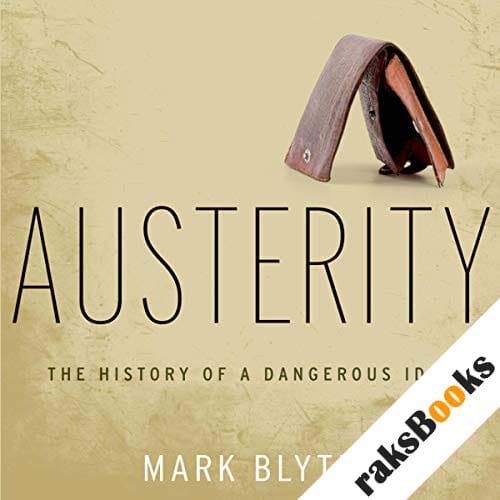
Austerity
The History of a Dangerous Idea

- Narrated by Fred Stella
- Length
- 11 hrs and 2 mins
- Release date
- 02-04-14
- Language
- English
Free to listen Chapter 1
AdYour audiobook continues right after
 Discover the full catalog
5 free listens and 5 downloads a day
High Quality
Listen in High Quality on raksBooks.com
This site streams in Low Quality for free. Studio-quality audio is available on raksBooks.com
Open on raksBooks.com
Daily free limit
You’ve used today’s free listens
- No daily limits
- High Quality audio
- Keep It Forever
12 chapters11h 2m
Publisher’s Summary
Governments today in both Europe and the United States have succeeded in casting government spending as reckless wastefulness that has made the economy worse. In contrast, they have advanced a policy of draconian budget cuts – austerity – to solve the financial crisis. We are told that we have all lived beyond our means and now need to tighten our belts. This view conveniently forgets where all that debt came from. Not from an orgy of government spending, but as the direct result of bailing out, recapitalizing, and adding liquidity to the broken banking system. Through these actions private debt was rechristened as government debt while those responsible for generating it walked away scot free, placing the blame on the state, and the burden on the taxpayer. That burden now takes the form of a global turn to austerity, the policy of reducing domestic wages and prices to restore competitiveness and balance the budget.
The problem, according to political economist Mark Blyth, is that austerity is a very dangerous idea. First of all, it doesn’t work. As the past four years and countless historical examples from the last 100 years show, while it makes sense for any one state to try and cut its way to growth, it simply cannot work when all states try it simultaneously: all we do is shrink the economy. In the worst case, austerity policies worsened the Great Depression and created the conditions for seizures of power by the forces responsible for the Second World War: the Nazis and the Japanese military establishment. As Blyth amply demonstrates, the arguments for austerity are tenuous and the evidence thin. Rather than expanding growth and opportunity, the repeated revival of this dead economic idea has almost always led to low growth along with increases in wealth and income inequality. Austerity demolishes the conventional wisdom, marshaling an army of facts to demand that we recognize austerity for what it is, and what it costs us.
Details
- Author
- Mark Blyth
- Narrator
- Fred Stella
- Length
- 11 hrs and 2 mins
- Release date
- 02-04-14
- Language
- English
Listen to Austerity for Free, Online or as a Download
You can listen to Austerity by Mark Blyth for free on ListenAudiobook.com. There's no trial to cancel and no card to enter. It runs 11 hrs and 2 mins, read by Fred Stella
Listen Free Online
Free audio books online don't get much simpler than this: press Listen and it plays. Keep browsing while it runs, then come back later and pick up where you stopped
Download for Free
Want it offline? Press Download and this free audiobook saves right to your phone, tablet or computer, ready for the commute, the gym or a long flight
Cheap Audiobooks on raksBooks.com
Want to keep the Austerity audiobook? It's on raksBooks.com in High Quality, along with thousands of cheap audiobooks. Download audio books once and they're yours for good

Listener Reviews
-
Excellent Book
An excellent interesting book about austierity, it's history how we got here today almost sixteen years since the 2008 and how austerity simony increased and empower extreme movements rather than decreasing it that polarization today has more to do with the economic environment and lack of jobs and cutbacks and assessing austierity in many forms an excellent book.
-
Fundamental info for me
Fundamental info for me with many examples and explanations. Despite books like this, right wing governments in my country (Czechia) does this aproach again and again.
-
Every politician needs to read this book
Any additional comments?
This book explains the history of economic austerity and how it has never worked and why it will never work. The author uses in-depth and sometimes complicated economic rationale to explain why but I think that is what lends so much legitimacy to his argument. I will admit it is not for the feeble minded but it is also not so complicated that the average concerned person can’t understand. He gives the reader a complete analysis of why public spending cuts never lead to economic growth and typically fuel rising debt instead of lowering it. He further details how the global financial crisis is really a private crisis of the banking sector and not a problem of public spending run amok. It is glaringly obvious that governments have allowed the finance industry to needlessly gamble and in many cases, have been forced to bail them out with public money. This book allowed me to finally understand the real reasons behind the European debt crisis and how much of it extends from several structural flaws in the Euro. I have read a number of books on the 2008/2009 financial crisis and I would say this is the best one yet. This really brought everything together for me as it really gets to the "why" behind a lot of the problems we see today. I like his analysis of Iceland at the end and I wish he had written much more on the topic. My only complaint is that the author quotes a number of economic theorists and sometimes it is hard to determine if he is still talking about their opinion or his own. Every politician should read this book and understand how cuts to public spending almost never produce the desired economic growth.
-
Much needed perspective
I studied business administration and finance in college. While I was there I had a hard time understanding a lot of classical economic ideas. This book among others like “Debt 5000 the 1st years” really put things into perspective for me. The focus on austerity is timely and a great frame work to understand other economic ideas of our age. There’s a lot of misunderstanding about classical economics. This is one of few books that helps people outside of the field to navigate the tricky political oceans.
-
A good overview
This can get a little hard to follow if you're not up on the last few decades of EU monetary kerfuffles, but the book isn't setting out to be an intro to international monetary policy. I thought his arguments were well laid out and supported with real world case studies, though I'm predisposed to agree with his conclusions. The writing style is accessible and not too dry, and the narrator is pleasant.
-
Brilliant
I'm somewhate familiar with Mark Blyth thanks to youtubin action. Wish he would have narrated it personally with his Scottish accent. Oh well. Still a great listen.
-
Great ideas, terrible voice over talent
Mark Blyth essentially gives these ideas away for free in his numerous YouTube videos on the subject. I had hoped for more content that isn't part of his numerous recorded lectures - this was disappointing in that respect. Also, having watched a number of these videos, Blyth has a distinctive rhythm and tone to his speech, and that comes across in his writing as well. Unfortunately, the narrator, Fred Stella, seems to be doing his best to imitate a machine trying to imitate human speech. He takes an already dense subject and makes it almost unlistenable. Just search for Mark Blyth on YouTube and watch the top five results. You'll get all the same information and hear it in Blyth's inimitable Glaswegian.
-
good read boring at times.
lots of information, found it hard to absorb all of it will listen to again.
Write a review
Thank you for your review!
It is now waiting for a quick moderation check and will appear on this page once approved — usually within a day.
Related Audiobooks
 Free Audiobook
Whispered Promises
 Free Audiobook
Business Law: Contracts
 Free Audiobook
Too Little, Too Late
 Free Audiobook
Anatomy of an Epidemic
 Free Audiobook
A Mate for York
 Free Audiobook
Whose Boat Is This Boat?
 Free Audiobook
The Kinship of Secrets
 Free Audiobook
The End of Animal Farming
 Free Audiobook
The Beast Within
 Free Audiobook
Paper Love
 Free Audiobook
My Life in a Cat House
 Free Audiobook
Kingdom of the Blazing Phoenix